Mildew and Grime Removed Without Paint Damage
House washing in Blairsville for vinyl, painted wood, and fiber cement siding that has developed visible mildew, staining, or grime buildup
Vinyl siding, painted wood, and fiber cement each require a different threshold of care when being cleaned, and the method used on one material is not automatically safe on another. Aaron's Pressure Washing, LLC uses a soft-wash process—a diluted chemical solution applied at low pressure—that addresses mildew, grime, and biological staining across all three material types without the force that removes paint or leaves fiber cement vulnerable to moisture intrusion at cut edges. The distinction matters because many homes in Blairsville were sided with painted wood or early-generation vinyl that has become more brittle and surface-sensitive than newer materials, and cleaning those exteriors with high pressure produces damage that becomes apparent only after the crew has left.
Application follows a specific sequence: surfaces are wet down first, the solution is then applied from the bottom of each section upward to prevent dry streaking where product contacts unwetted wall above, and the solution is allowed to dwell before rinsing. The bottom-up application is a process discipline that many crews skip because it takes more care to execute on ladders and around obstacles, but skipping it produces the uneven vertical streaking that makes a freshly washed house look worse in certain light conditions. After the dwell period, the surface is rinsed at low pressure and the mildew and grime flush cleanly without residue.
Request an exterior walkthrough to identify the siding type and the specific areas showing the most buildup before scheduling the wash.
What Proper House Washing Actually Requires
The chemical mixture used in soft washing is diluted specifically for exterior residential surfaces—concentrated enough to break down mildew and organic material during the dwell phase, but not so strong that it affects paint adhesion or leaves residue on window seals and trim. Getting that dilution right matters because under-diluted solution can bleach painted surfaces unevenly, and over-diluted solution will not clear the organic material effectively and will require re-treatment. Aaron's Pressure Washing, LLC applies the same method the owner has been using since he began pressure washing at fifteen—the consistency comes from running the business himself rather than delegating to crews with varying habits.
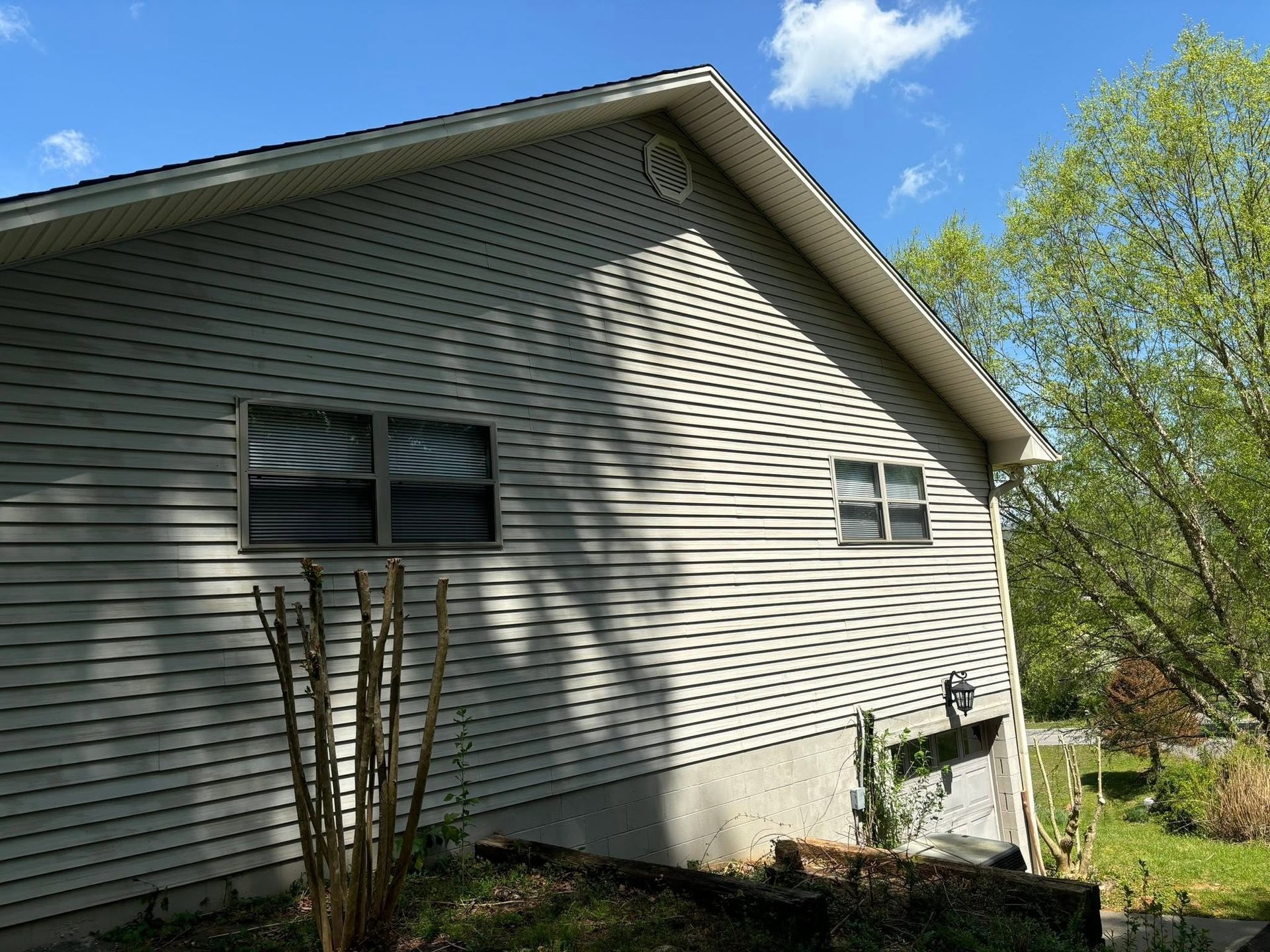
After the wash is complete, the siding surface is visibly cleaner and uniform: no dark patches at the base of panels where mildew concentrates, no green tint on north-facing walls that stay shaded, and no gray film across surfaces that looked faded but were actually coated in embedded grime. Painted wood trim that appeared chalky or discolored often shows its original color clearly once the biological layer is gone—which occasionally reveals that repainting is not yet needed.
Window frames, light fixtures, and exterior outlets are areas where rinse water and solution contact need to be managed carefully. The crew accounts for those features during the wet-down and rinse phases rather than treating them as an afterthought. Screens are typically removed or protected where solution contact could cause staining, and any landscaping at the base of the walls is flushed after the work is complete to clear any solution that reached the ground during rinsing.
Common Questions About the House Washing Process
House washing decisions depend on the specific siding material, the age of the surface, and how the solution is applied. The questions below address what happens during the work and what you will see afterward.
Why is the solution applied from the bottom of the wall upward instead of starting at the top?
Applying from the top down allows product to run over dry wall surface below it, where it can dry before the crew reaches that section and create streaks that are difficult to remove uniformly. Starting at the bottom keeps the entire section wet as product is applied, which prevents differential drying and produces a consistent result across the full wall height.
How does the condition of painted wood siding affect how the wash is approached?
Painted wood that has micro-cracking or peeling at the surface edges is more vulnerable to moisture intrusion than sound paint, so the rinse phase uses lower pressure and keeps the stream moving rather than dwelling on any one spot. Areas with loose paint are noted before the wash begins so the crew can adjust technique around them rather than discovering damage afterward.
What happens to mildew at the base of siding panels where it tends to concentrate?
Mildew concentrates at the bottom of panels and at horizontal trim lines because those surfaces retain moisture longer and receive less direct light. The dwell phase of the soft-wash process targets those areas specifically—the solution has the most contact time where it needs it—and the rinse clears the loosened material completely rather than just lightening the visible color.
How do homes in Hayesville and Cleveland with fiber cement siding get washed differently than vinyl?
Fiber cement is porous at cut edges and absorbs water more readily than vinyl, which means the rinse phase needs to move deliberately and not saturate the material. The approach is soft-wash regardless of material type, but the rinse angle and duration are adjusted on fiber cement to avoid directing pressure into horizontal panel edges where moisture retention can cause delamination over time.
How can you tell the wash was done correctly once the surface dries?
A properly washed surface dries to a uniform color with no streaking, no dark patches at horizontal joints, and no white residue from solution that was not fully rinsed. If any section shows uneven drying or visible product residue, that area needs a follow-up rinse before the job is considered complete.
Aaron's Pressure Washing, LLC also performs house washing in Dahlonega, Helen, Cleveland, Young Harris, and Hayesville. To schedule service or discuss the specific siding materials on your home, call (706) 897-1862.