Streaked Shingles Cleaned Without Lifted Granules
Roof cleaning in Blairsville for shingles showing algae, moss, and black streaking that accumulates faster on shaded lots
The black streaking that appears across asphalt shingles is not dirt in the conventional sense—it is Gloeocapsa magma, a cyanobacteria that spreads from spore to visible colony across a roof surface and feeds on the limestone filler embedded in the shingles themselves. Aaron's Pressure Washing, LLC removes that growth using a diluted chemical application rather than high pressure, which matters because pressure strong enough to blast off algae and moss is also strong enough to strip the protective granule layer that gives asphalt shingles their rated service life. Once granules are lost, the underlying mat degrades faster and the warranty on most shingle products is voided.
The process involves applying a diluted solution directly to the shingle surface and allowing it to dwell long enough to break down the biological material at its root rather than just displacing it. After the dwell period, the surface is rinsed gently so the dead material flushes away without mechanical stress on the granules. Shaded mountain lots in this area accumulate visible growth faster than open lots because the tree canopy limits UV exposure, which is the natural check on algae development—meaning the problem returns more quickly and periodic soft-wash treatment is the practical maintenance approach.
Arrange a roof evaluation to assess current growth coverage and identify which sections are showing the earliest signs of spread.
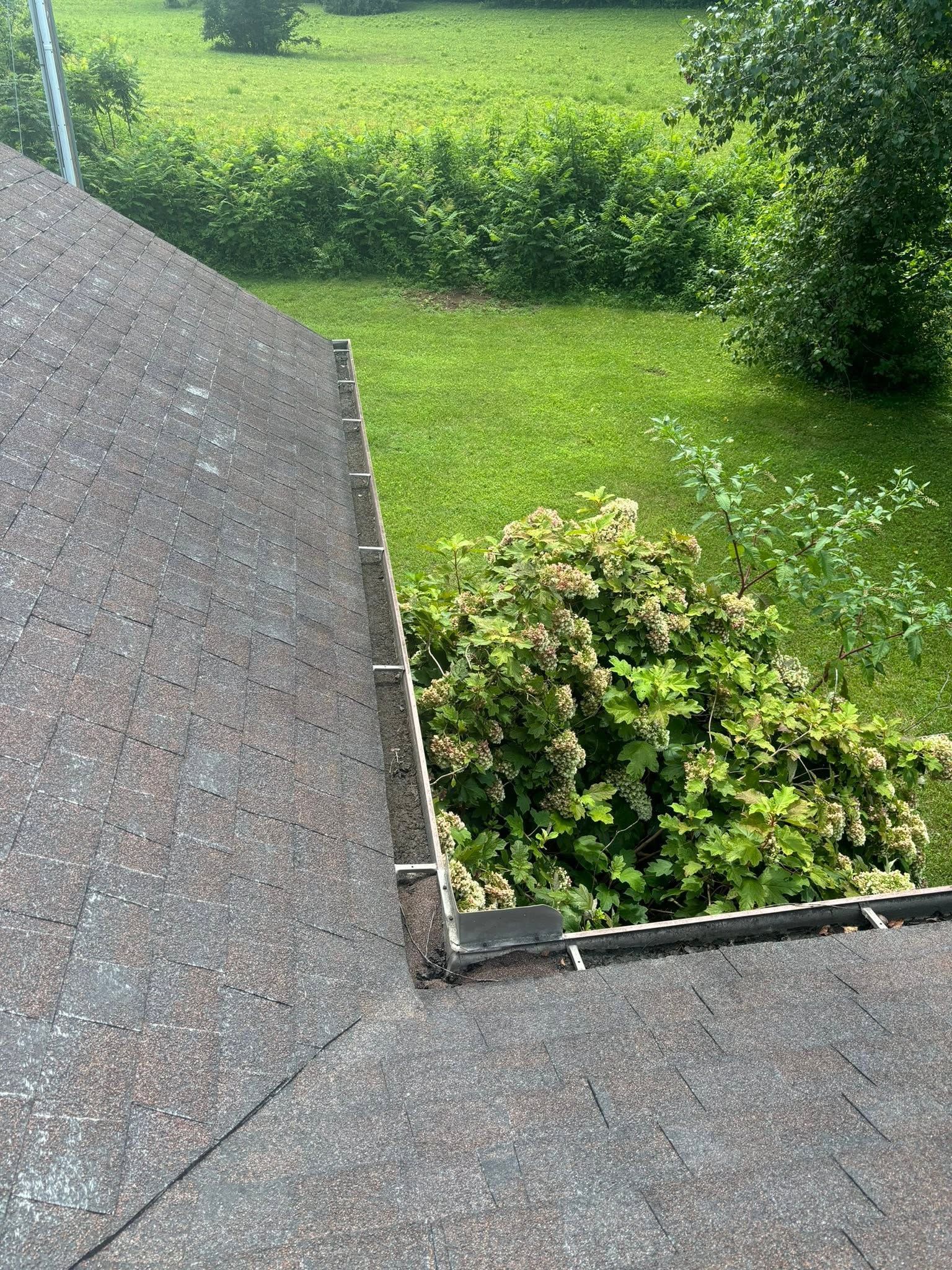
Why the Cleaning Method Determines What Happens to the Shingles
Asphalt shingles are manufactured with a granule surface embedded into an asphalt-saturated mat, and those granules serve two functions: they reflect UV radiation to slow asphalt degradation, and they form the visible surface layer that gives the shingle its texture and color. A pressure washer set high enough to physically remove algae colonies applies force that dislodges granules in the same pass. You cannot see the granule loss from the ground, but the shingles will shed years of service life invisibly—and most roofing manufacturers cite high-pressure washing as a basis for voiding the product warranty.
After a proper soft-wash treatment, the shingle surface will be visibly uniform: the black streaking is gone, the original color of the shingle returns, and any green or orange moss coverage is dead and will shed on its own over the weeks following treatment. Aaron's Pressure Washing, LLC does not use high pressure on shingles regardless of how heavy the growth appears—the chemical solution is what does the work, and dwell time determines how thoroughly the growth is addressed.
Moss that has heavy rhizoid attachment—the root-like structures that anchor it to the shingle—may not flush completely in a single rinse and will shed gradually as it dries and dies. That is normal for the soft-wash process and does not indicate incomplete treatment. What it means in practice is that a roof cleaned in the spring may look progressively cleaner over several weeks as the dead material releases, rather than clearing completely on the day of service.
Answers About How Roof Cleaning Works
Roof cleaning involves specific decisions about chemistry, sequencing, and surface protection that are worth understanding before the work begins. These questions focus on the process itself.
What does the chemical solution actually do to algae and moss on shingles?
The diluted solution breaks down the biological material at a cellular level, killing the organism rather than just displacing it. This is why properly cleaned shingles stay cleaner longer than a surface that was pressure-washed—the growth was killed, not relocated.
How does the crew apply the solution without it running off the shingles before it has time to work?
The solution is applied at low pressure with a volume and viscosity that allows it to sit on the shingle surface rather than sheeting off immediately. On steeper pitches, application may start lower on the roof and work upward in sections to maintain contact time across the full surface.
Why does shaded roofing in the Blairsville area develop growth faster than roofs in more open locations?
Tree canopy reduces UV exposure on the shingle surface, and UV radiation is one of the primary environmental factors that limits algae and moss growth naturally. Lots with heavy north-side or full canopy coverage can show visible streaking and moss within a few years of a previous cleaning, while open-lot roofs of the same age may show minimal growth.
What is the difference between algae streaking and moss, and does that change how the roof is treated?
Algae streaking appears as flat, dark discoloration that runs with the shingle profile, while moss develops as a raised, textured growth with visible structure. Both respond to the same chemical soft-wash method, but heavy moss coverage requires a longer dwell period because the rhizoid layer resists penetration more than a flat algae film.
How can you tell if a roof has been cleaned correctly once the work is finished?
The shingle color should be uniform without dark bands or green patches, and any moss that was present should appear bleached or gray rather than green. Full shedding of dead moss may take several weeks, but the growth should show no signs of remaining viable—no green coloration and no new spread at the edges of treated sections.
Aaron's Pressure Washing, LLC also performs roof cleaning in Helen, Dahlonega, Cleveland, Young Harris, and Hayesville. Call (706) 897-1862 to discuss the growth patterns on your roof and schedule a treatment appointment.